
iPhone 18 Pro camera guide
Variable aperture
still needs ND.
Apple finally gave the main camera an f/1.48 to f/4 iris. Great for depth of field. Not enough for cinematic shutter speeds in hard daylight.
Scroll any iPhone 18 Pro review and you will hit the same headline: a real variable aperture on the 48MP main camera, from f/1.48 wide open down to f/4. People are already asking the obvious follow-up.
If the phone can close the iris, do you still need an ND filter?
Short answer: yes, if you care about cinematic motion in daylight. Variable aperture changes how much of the scene is sharp and trims a little light. An ND filter cuts light without forcing you to abandon the f-stop you chose for the look. Those are different jobs.
What does the iPhone 18 Pro variable aperture actually do?
On earlier Pro iPhones, the main lens sat at a fixed aperture (around f/1.8). You could fake blur in Portrait mode, but you could not physically open or close the iris.
The iPhone 18 Pro and Pro Max change that on the main camera only. Reviews from The Verge, PCMag, Tom’s Guide, Fstoppers and PetaPixel all land on the same hardware story: a six-blade diaphragm with four user-facing stops, f/1.48, f/1.8, f/2.8 and f/4. Auto mode often parks near f/1.8 in good light, opens to f/1.48 when the room gets dark, and can close toward f/4 for group shots or close text where you want more of the frame sharp.
That matters for two reasons:
- Depth of field: f/1.48 can give a little more optical background separation when your subject is close. f/4 pulls more of the scene into focus. Distance still rules the look. Stand seven feet back and the gap between those stops gets subtle.
- Exposure: closing the iris reduces light hitting the sensor. Moving from f/1.48 to f/4 is roughly three stops. Useful. Not a daylight ND replacement.
Does the iPhone 18 Pro variable aperture replace an ND filter?
No. Not for bright daylight video at cinematic shutter speeds.
An ND filter is sunglasses for the lens. It reduces light while you keep the aperture and shutter you already picked. Variable aperture also reduces light, but only by changing the creative setting that shapes focus. If you want creamy separation at f/1.48 or a balanced f/1.8, closing to f/4 just to darken the frame is the wrong trade.
PCMag put it plainly after launch: for interiors, night, and twilight, the f/1.48-f/4 range can help with motion blur and shutter choice. Under sunny skies, you will still want ND. Fstoppers ran the same math for video: lock 1/48 at a low ISO with the iris at f/4 in midday sun and the image still blows out.
Variable aperture
What it controls
- Primary job
- Depth of field
- Light range
- ~3 stops (f/1.48 to f/4)
- Side effect
- Changes sharpness plane
- Best indoors
- Often enough alone
- Harsh noon sun
- Usually not enough
Use it whenYou want more or less of the scene in focus
ND filter
What it controls
- Primary job
- Light only
- Typical range
- 1-5, 3-7, or fixed stops
- Side effect
- Keeps your chosen f-stop
- Best indoors
- Optional
- Harsh noon sun
- Still essential
Use it whenYou need 1/48-1/60 shutter without raising ISO drama
Our own Freewell Gear channel put the iPhone 18 Pro Max aperture through a full camera test. Watch how the new iris behaves in real light, then keep reading for why ND still finishes the exposure.
Watch on YouTube: Freewell iPhone 18 Pro Max camera test (why f/1.48 is not the whole story)
Why do you still need an ND filter for the 180-degree shutter rule?
Cinema has a simple habit: shutter speed near double the frame rate. Shoot 24 fps, aim for about 1/48. Shoot 25 fps, aim for 1/50. Shoot 30 fps, aim for 1/60. That is the 180-degree shutter rule. It puts a natural amount of motion blur into every frame so walking, traffic, and hand moves feel like film instead of a choppy sports broadcast.
On a bright street, the iPhone can expose a clean still at 1/1000 or faster. For video, you do not want that. You want the shutter parked near 1/48 while ISO stays low. Closing the iris to f/4 buys you roughly three stops from wide open. In midday sun that is often still not enough, especially if you also want to stay near f/1.8 for a preferred look.
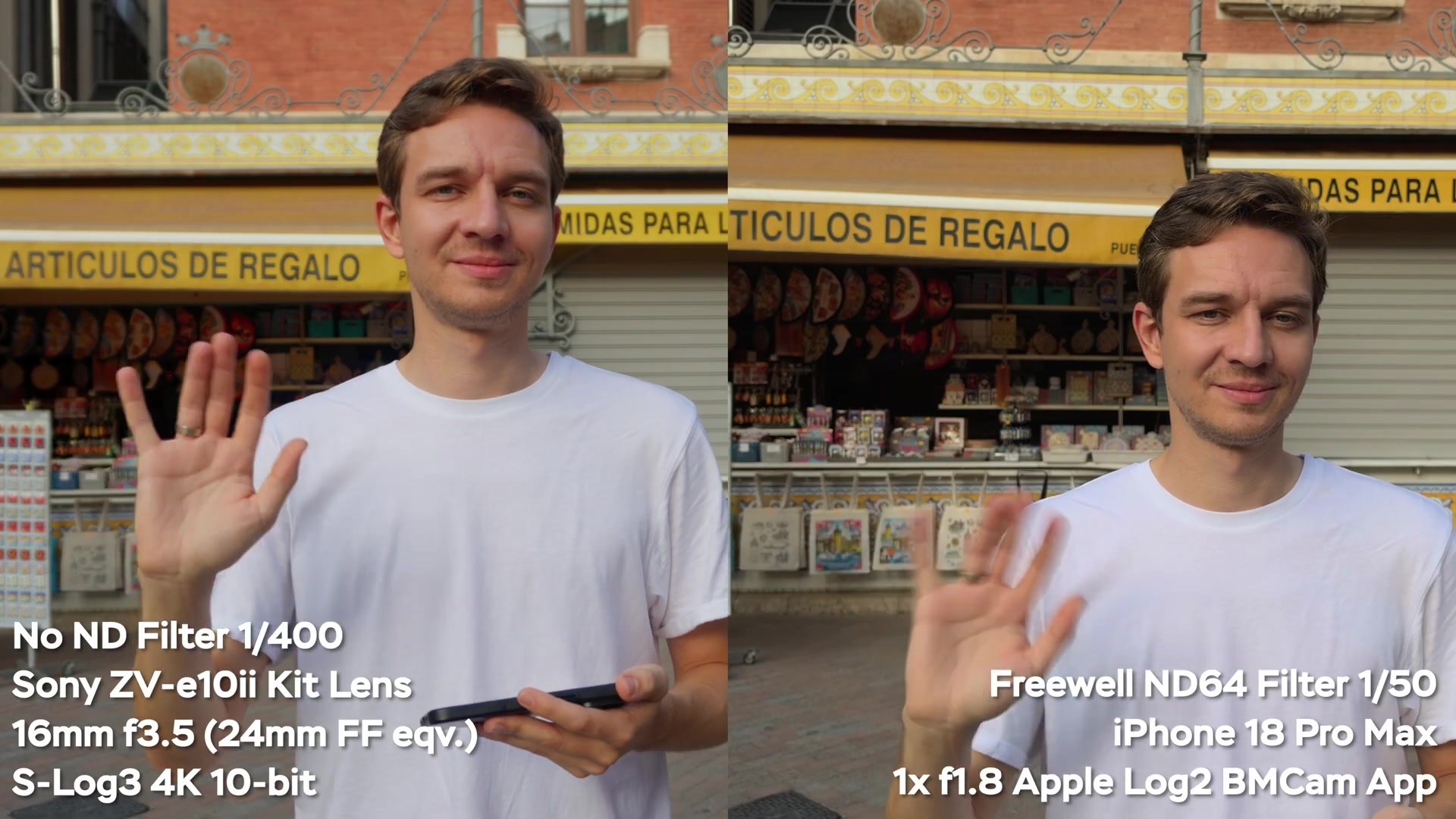
Quick daylight check: set 24 or 25 fps, lock shutter at 1/48 or 1/50, keep ISO as low as the app allows, and try f/4. If highlights are still clipped, the iris has done all it can. That is when a variable ND earns its place on the case.
Want the short Freewell primer on variable ND itself? This clip covers why, when, and how to use a VND when shutter speed and look matter more than Auto exposure.
Watch on YouTube: Variable ND filter (VND) why, when, and how
How many stops does f/1.48 to f/4 really give you?
Roughly 2.9 stops, often rounded to three. In ND language that is close to an ND8. Handy for cloudy afternoons, shaded streets, or indoor windows. Weak against beach sun, snow, desert noon, or any scene where you already wanted a wider aperture for subject separation.
Think in layers instead of replacements:
- Choose aperture for depth of field.
- Lock shutter for the motion look you want.
- Use ND to finish the exposure without climbing ISO.
A scene that needed about six stops of ND at f/1.48 might only need about three once you close to f/4. That can mean dialing a lighter VND range. It does not mean leaving the filter at home on a bright day.
When can you skip the ND filter on an iPhone 18 Pro?
Plenty of real shoots do not need one:
- Dim interiors and night streets: f/1.48 is there to gather light. Adding ND would fight the phone.
- Run-and-gun social clips: if you are happy with Auto shutter and a crisp look, skip the kit.
- Stills with deep focus: f/4 can help menus, products, and group photos without any filter.
- Soft overcast video: sometimes f/2.8 or f/4 alone holds 1/48 cleanly.
Bring ND when the brief is cinematic daylight: travel films, interviews near windows, skate or street pieces, beach content, or any locked-off shot where you want silky water and natural motion blur.
How do you pair aperture and ND on the iPhone 18 Pro?
Use the phone’s Pro controls (or a manual app such as Blackmagic Camera) and treat the Freewell case as the mount for light control.
Prefer one filter that also kills glare on water, glass, and car paint? The iPhone Magnetic Hybrid VND 3-7 Stop + CPL Filter combines variable ND and a circular polarizer, so you can darken the scene and rotate out reflections without stacking two rings.
See the magnetic Hybrid system snap onto a Freewell case in about a second, with independent VND and CPL rings for daylight control.
Watch on YouTube: Freewell iPhone filter system for mobile filmmaking
Which Freewell gear fits the iPhone 18 Pro aperture workflow?
Apple gave you an iris. Freewell gives you the missing light control that snaps on in a second and stays out of the way.

Daylight control
Magnetic Hybrid VND 3-7 Stop + CPL
3-7 stops of ND · independent CPL · True Color · magnetic mount
$79.99
SHOP THE FILTER →
The mount
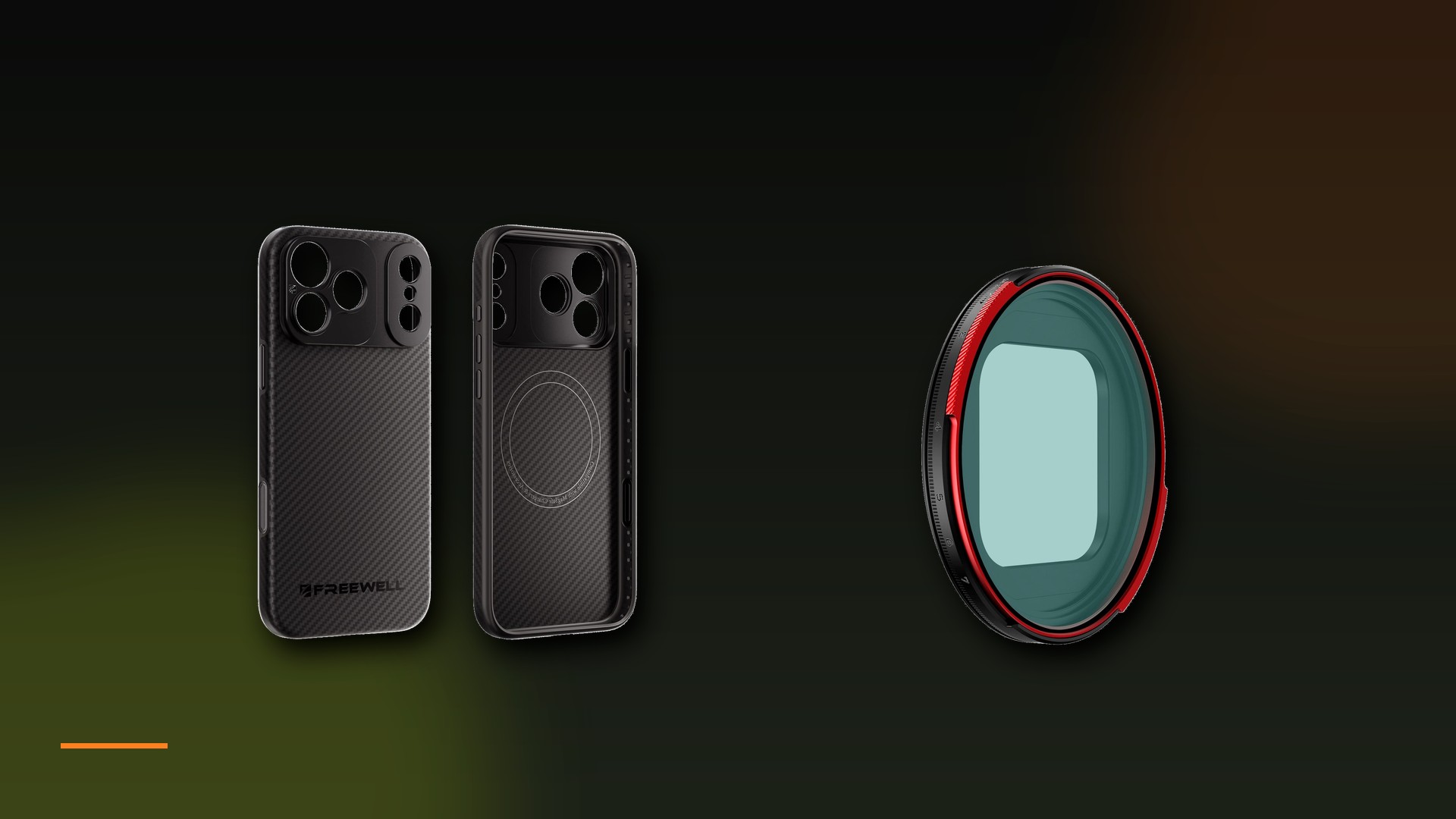
iPhone 18 Pro Max Filmmaker Case
Kevlar · MagSafe · Sherpa magnetic filters · 17mm lens mount
$79.99
SHOP THE CASE →
Start here
iPhone Pro Filmmaker Basic Kit
Filmmaker Case + True Color VND 1-5 stop in one kit
$149.99
SHOP THE KIT →Shooting the smaller iPhone 18 Pro body? There is a matching iPhone 18 Pro Filmmaker Case with the same magnetic filter plate and 17mm lens thread. Filters are shared across Freewell Sherpa cases; pick the case that fits your exact phone.
Variable aperture vs ND: what should you buy first?
If you already own an iPhone 18 Pro or Pro Max, you already own the iris. The first accessory that changes daylight video is still a case with a proper magnetic filter mount, then a VND.
- Most people: Filmmaker Case + VND 1-5 Basic Kit. Simple, light, fast to learn.
- Travel and outdoor filmmakers: Case + Hybrid VND/CPL 3-7 when glare and strong sun show up in the same shot.
- Lens curious creators: keep the case, because the 17mm mount also accepts Freewell anamorphic, wide, and tele lenses later.
Final thoughts
The iPhone 18 Pro variable aperture is a real upgrade. It opens a bit wider for low light, closes for deeper focus, and gives videographers more shutter flexibility than a fixed iris ever did.
It does not retire the ND filter. Three stops is not the same as dedicated neutral density when the sun is high and you refuse to abandon 1/48. Use the iris for depth of field. Use ND for light. Your footage will look calmer, more intentional, and a lot closer to the cameras people still haul in bags.
Aperture for look. ND for light.
Keep the cinematic shutter.
Leave the blown highlights behind.
Pair the iPhone 18 Pro Max Filmmaker Case with a magnetic VND, then dial stops until 1/48 looks right in open sun.
SHOP THE BASIC KIT →