Direct answer: Alessio Furlan thinks they are, if you don’t already own a similar kit. He praises how thin the filters are (2.95mm for the NDs), the bayonet-style lock that keeps stacked magnetic filters from falling off, and the lack of vignetting from the large filters. His criticisms: only one front and one rear cap, a UV filter and 1/8 Mist in the Photography Kit that he finds unnecessary, and no variable ND in the video kit. He tested the 95mm Photography Kit.
Video summary: what Alessio Furlan shows
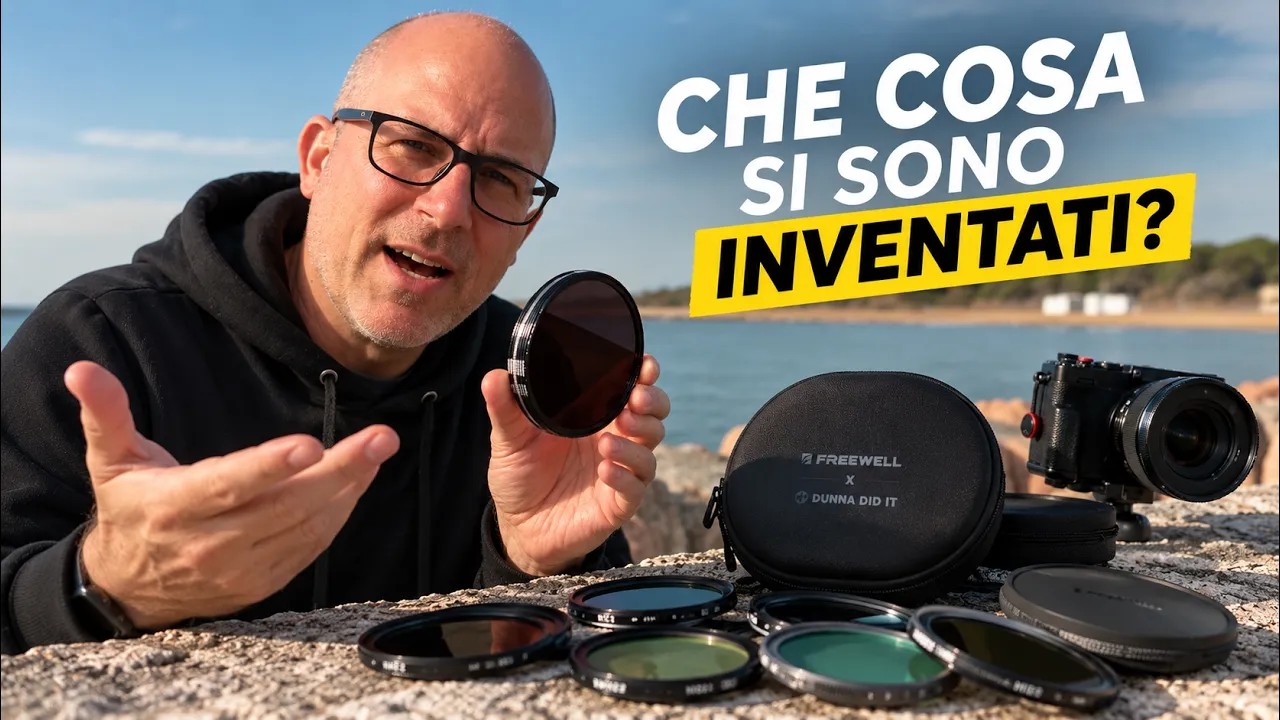
Alessio Furlan, an Italian photographer, reviews the Freewell x Dunna Did It Ultra-Slim Locking system from a beach shoot. He is upfront that the video is sponsored. Freewell sent the kit, and he says he isn’t pushing one brand over another. He also gives blunt advice: if you already have a similar filter kit, don’t switch. The video is in Italian. Our summary is based on the English caption track YouTube provides.
He reviews the Photography Kit: UV, ND64, ND1000, a CPL and a 1/8 Mist, plus front and rear caps with a white, black and neutral grey balance reference. Freewell lists a separate Videography Kit with ND4, ND8, ND16, ND32 and Glow Mist 1/4. He explains that the system was designed with a photographer and videomaker to fix five common problems.
The first problem is bulk. He measures the NDs at 2.95mm, the Mist at 3.45mm and the two-glass CPL at 5.3mm, and calls them the slimmest filters he has used recently. The second is fit: he uses one large 95mm kit with adapter rings across his lenses, which also avoids vignetting on wide angles. The third is speed, since a screw-on base ring lets the filters attach magnetically. The fourth is security. A bayonet-style twist lock holds the stack so firmly that he lifts the camera by the filters, so a bump in a backpack won’t knock a filter off. The fifth is that each filter is color-coded so you can find it quickly in the case.
He spends a chapter on why there is no variable ND. A VND is two polarizers working together, so some near-infrared light can leak through and show up as a magenta cast in the shadows, depending on the filter. It can also polarize the light in ways that aren’t neutral. Fixed NDs avoid both problems, and you can still stack an ND with the CPL.
His strengths list covers optical quality, thinness, the lock, zero vignetting, one diameter for every lens (you need this system’s own adapter rings), and how compact the kit is. Then he goes through the criticisms. He disagrees that the large hard case is a flaw, because it holds both kits. He agrees that one front and one rear cap isn’t enough, because the front cap goes on the lens while the filters sit unprotected, so buy extra caps. He finds the UV filter unnecessary, and the 1/8 Mist unnecessary for photos since you can add that look in editing, though it makes sense for video. He also partly agrees that the video kit would be more flexible with a variable ND.
Key takeaways
Key takeaways
- Truly slim. 2.95mm NDs, 3.45mm Mist, 5.3mm CPL. The slimmest filters he has used recently.
- Locks, not just magnets. The twist lock held a stack firmly enough for him to lift the camera by the filters, so bumps in a bag won’t knock one off.
- One size, every lens. A large ring size plus this system’s adapter rings covers all his lenses with no vignetting on wide angles.
- No VND, on purpose. He explains the VND trade-offs (possible magenta cast from infrared, non-neutral polarization) and why fixed NDs avoid them.
- Buy extra caps. The kit has one front and one rear cap, so if filters are off the lens they sit unprotected.
- Photo kit extras. He finds the UV and 1/8 Mist unnecessary for stills. The Mist makes more sense for video.
Who this video is for
Watch this if you
- are building your first serious magnetic filter system
- shoot wide-angle landscapes and worry about vignetting
- want an honest pros-and-cons review, not an unboxing
Maybe skip it if you
- already own a similar magnetic kit (his own advice)
- need a variable ND for fast-changing video light
Timestamps
Freewell gear in the video

THE KIT HE REVIEWS
Dunna Did It Ultra-Slim Locking Photography Kit – 95mm
UV, ND64, ND1000, CPL and Glow Mist 1/8 with a 95mm base ring. Also sold in 67-86mm.
VIEW PHOTOGRAPHY KIT ↗
FOR VIDEO
Dunna Did It Ultra-Slim Locking Videography Kit – 95mm
ND4, ND8, ND16, ND32 and Glow Mist 1/4 with a 95mm base ring. Fixed NDs only, no VND.
VIEW VIDEOGRAPHY KIT ↗
ADAPT TO EVERY LENS
Dunna Did It Base Ring
The system-specific ring he says you need for each lens. 49mm to 95mm sizes.
VIEW BASE RINGS ↗Frequently asked questions
Are the Freewell Dunna Did It Ultra filters worth it?
How thin are the Dunna Did It Ultra filters?
Why is there no variable ND in the Dunna Did It kits?
What are the downsides of the Dunna Did It Ultra kit?
Do I need special adapter rings?
Credit: Video by Alessio Furlan on YouTube, uploaded Oct 29, 2026. Watch the full video on YouTube and subscribe to Alessio Furlan for more.